
Top 5 Tools for AI-Powered Demand Forecasting
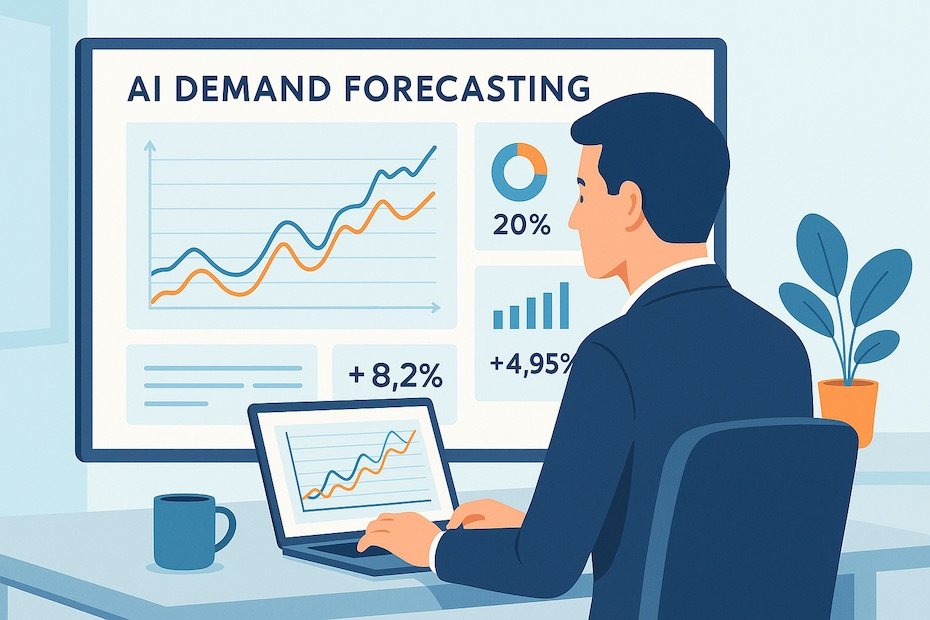
Table of Contents
- 1. C3 AI Demand Forecasting – Enterprise-Level Predictive Accuracy
- 2. Infor Demand Forecasting – Real-Time Planning and Demand Sensing
- 3. Prediko – Smart Demand Planning for E-Commerce and SMBs
- 4. Kinaxis RapidResponse – Real-Time Scenario Modeling
- 5. Logility – AI Forecasting Integrated with Supply Chain Execution
- How to Choose the Right AI Demand Forecasting Tool
- Implementing AI Forecasting Tools Successfully
- Common Challenges in AI Demand Forecasting
- Best AI Demand Forecasting Tools
- Take Command of Your Forecasting Future
You can enhance accuracy, reduce costs, and align production with real-time market signals by using AI-powered demand forecasting tools. These platforms apply advanced algorithms to predict consumer demand, allowing you to plan inventory, procurement, and logistics with precision.
In this guide, you’ll explore the top AI forecasting tools used by global enterprises, what makes each one unique, and how to integrate them effectively into your operations. By the end, you’ll know which solution best fits your scale, data ecosystem, and performance objectives.
1. C3 AI Demand Forecasting – Enterprise-Level Predictive Accuracy
C3 AI Demand Forecasting delivers enterprise-grade intelligence that blends historical, transactional, and external data to generate precise demand forecasts across SKUs and regions.
Its AI algorithms learn from multiple sources—past orders, promotions, weather, and even macroeconomic indicators—to predict demand fluctuations. The system continuously refines itself, improving forecast accuracy as it absorbs new data. According to user reports, organizations see up to 30% improvement in forecast accuracy and 7% reduction in inventory levels after deployment.
C3 AI’s major strength lies in scalability. It handles thousands of products, across hundreds of locations, with automated model training and deployment. The platform also integrates easily with major ERP and SCM systems, allowing you to connect forecasting directly to execution.
If your business operates across multiple geographies or deals with complex product hierarchies, C3 AI provides the power, visibility, and precision you need to make proactive planning decisions.
2. Infor Demand Forecasting – Real-Time Planning and Demand Sensing
Infor Demand Forecasting is built for agility and speed. It uses AI to sense demand shifts in near real time and automatically adjusts your forecasts as new data streams in.
You can monitor patterns at the SKU level, detect anomalies, and generate alerts when demand spikes or drops unexpectedly. Its embedded machine learning algorithms factor in promotions, events, and seasonality, making it ideal for fast-moving consumer goods (FMCG) and retail sectors.
Infor’s major advantage is its integration with the Infor Supply Chain Planning suite, which connects forecasting with replenishment, production, and procurement. This eliminates the disconnect between planning and execution, allowing your teams to act on AI-generated insights instantly.
For high-velocity markets that require frequent forecast updates, Infor gives you the responsiveness to balance service levels with minimal inventory.
3. Prediko – Smart Demand Planning for E-Commerce and SMBs
Prediko offers accessible, AI-powered demand forecasting tailored for e-commerce and mid-sized businesses. It’s designed to simplify the forecasting process while maintaining enterprise-grade intelligence.
The platform tracks sales data, reorder points, and supplier lead times to help you automate replenishment decisions. You can monitor performance across multiple channels—Shopify, Amazon, or WooCommerce—and get real-time reorder alerts when SKUs are at risk of going out of stock.
Prediko stands out because it translates analytics into actionable tasks. Instead of just showing trends, it recommends what to order, when to order, and how much to order. It’s ideal if you’re managing a growing SKU catalog and need better control over cash flow and inventory turns.
If you’re scaling an online retail business, Prediko bridges the gap between forecasting sophistication and simplicity of execution—without requiring a dedicated data science team.
4. Kinaxis RapidResponse – Real-Time Scenario Modeling
Kinaxis RapidResponse is one of the most advanced platforms for complex global supply chains. It goes beyond traditional demand forecasting to provide simulation and scenario planning capabilities that help you anticipate change before it happens.
Its AI-powered Demand.AI engine uses predictive modeling to evaluate multiple “what-if” scenarios—how promotions, supply delays, or demand shocks might affect inventory and service levels. You can instantly simulate potential outcomes, compare them, and adjust your plans accordingly.
Kinaxis enables synchronized planning across teams, so demand signals automatically update supply, manufacturing, and logistics plans. That makes it invaluable for large manufacturers, consumer goods producers, and distributors with intricate supply networks.
Companies that implement Kinaxis report significant gains in responsiveness and cost reduction due to faster reforecasting and enhanced visibility across their value chain.
5. Logility – AI Forecasting Integrated with Supply Chain Execution
Logility combines AI-driven demand forecasting with advanced analytics and supply chain optimization, making it a top choice for companies that want one platform for planning and execution.
The system models multiple causal factors—pricing, macroeconomic indicators, and seasonality—to forecast demand with high accuracy. It also provides interactive dashboards that visualize demand trends, inventory positions, and forecast deviations.
Where Logility excels is in connecting forecasting to operations. It helps you translate predictions into replenishment plans, supplier orders, and production scheduling. Its collaboration tools enable cross-functional visibility, so teams in marketing, sales, and operations work from the same demand plan.
If your organization seeks to unify strategic forecasting with day-to-day operational alignment, Logility provides the integrated infrastructure to make that happen seamlessly.
How to Choose the Right AI Demand Forecasting Tool
Selecting the right tool depends on your data readiness, business complexity, and growth goals. Start by assessing how your current system performs—what data gaps exist, how frequently your forecasts need updating, and which business functions rely on them.
Look for these must-have capabilities:
- Data integration flexibility: The ability to connect sales, inventory, and external data sources.
- Scalable architecture: Systems that grow with your business without compromising speed or accuracy.
- Explainable AI: Transparency into how predictions are made, which improves adoption and trust.
- Cross-functional usability: Platforms that support planners, operations, and finance teams simultaneously.
- Performance tracking: KPI dashboards for forecast accuracy, service levels, and cost-to-serve.
When you align your selection with measurable goals—like reducing forecast error by 20% or cutting stock-outs by 15%—you can quantify ROI faster and build executive support for scaling the solution.
Implementing AI Forecasting Tools Successfully
Adopting AI forecasting requires preparation and disciplined execution. Treat it as an ongoing performance system rather than a one-time software installation.
Begin with clean data. Even the most advanced model can’t perform well if your historical data is incomplete or inconsistent. Work with your IT or analytics teams to centralize and validate your datasets before rollout.
Run pilots in a focused area—like one product line or distribution center. Measure baseline KPIs such as MAPE (Mean Absolute Percentage Error), on-time fulfillment, and inventory turnover. Once results prove positive, scale gradually to additional regions or product lines.
Sustain success by maintaining human oversight. AI is powerful, but planners still play a vital role in interpreting external signals and validating anomalies. Combine algorithmic predictions with planner expertise to achieve consistent performance.
Common Challenges in AI Demand Forecasting
Even advanced forecasting systems face hurdles if they’re not managed correctly. Common issues include poor data governance, lack of user adoption, and over-reliance on automated output.
If your team doesn’t trust the system’s predictions, they’ll default back to manual processes. Prevent this by training staff to interpret forecasts and by setting realistic expectations about accuracy improvement timelines.
You should also avoid “black box” algorithms that offer predictions without transparency. Choose systems that explain why forecasts change—whether due to weather, promotions, or supplier delays. That clarity helps users make better decisions, not just follow machine recommendations blindly.
The key is maintaining the balance between automation and human judgment—leveraging AI as a decision enhancer, not a decision replacer.
Best AI Demand Forecasting Tools
- C3 AI Demand Forecasting: Enterprise-level accuracy with predictive analytics.
- Infor Demand Forecasting: Real-time planning and demand sensing.
- Prediko: Simple, smart, and scalable for e-commerce.
- Kinaxis RapidResponse: Scenario-driven forecasting and simulation.
- Logility: Forecasting integrated with full supply chain planning.
Take Command of Your Forecasting Future
AI demand forecasting is no longer optional—it’s an operational necessity for companies that want to stay ahead of market volatility. By integrating data science into your planning cycle, you reduce waste, improve responsiveness, and unlock measurable performance gains.
Choose a platform that aligns with your data maturity and business goals. Implement it systematically, monitor metrics consistently, and keep improving. Over time, forecasting becomes less about prediction and more about precision.
To explore more on AI-driven planning and next-generation forecasting strategies, connect with me on my website where I share actionable insights and case studies for supply chain leaders.
Related Posts

How to Build a Strong Resume as a Student With No Experience
Learn how to build a strong student resume with no experience...

How to Memorize Faster and Retain Information Longer
Learn how to memorize faster with active recall, spaced repetition, and...
How AI Is Changing Supply Chain Jobs (And What Skills Will Still Matter)
See how AI is changing supply chain jobs and which human...